The traditions behind the stage
Uzbek dance and music by region
A guide to the Uzbek dance and music traditions a Samarkand concert draws on: Khorezm's Lazgi, the Fergana Valley's Katta Ashula and Shashmaqom.
Reserve a seat in Samarkand ↗Quick answer
Uzbek performing traditions differ by region. Khorezm is tied to the dance Lazgi, which UNESCO inscribed in 2019. The Fergana Valley is tied to Katta Ashula, a song form for two to five singers inscribed in 2009. Bukhara is the historical centre of Shashmaqom, a classical vocal and instrumental tradition inscribed in 2008. A Samarkand concert show draws on this variety rather than on one style.
One country, several traditions
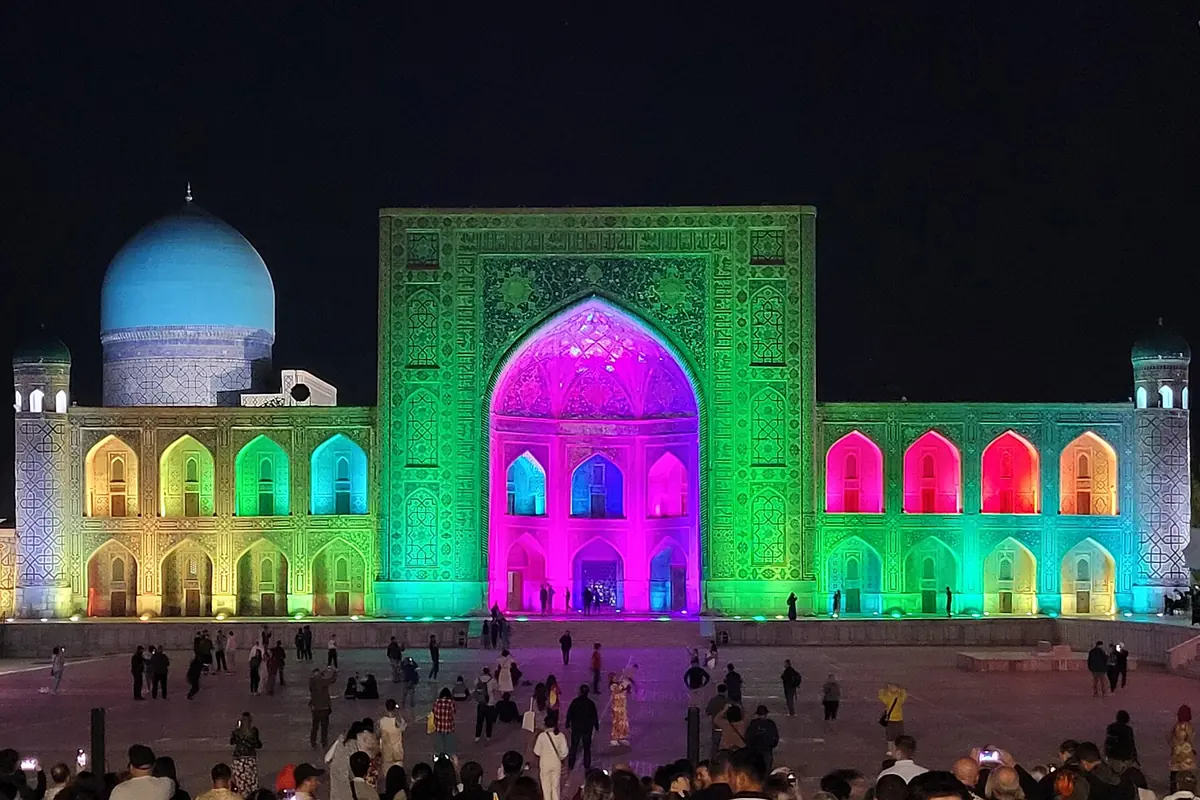
Uzbekistan is often regarded as one of the most musically diverse countries in Central Asia, and Wikipedia credits that to the long history of its music and the large variety of styles and instruments. The performing arts are not a single folk repertoire. They vary with the region: Khorezm, the Fergana Valley, the old cities of Bukhara and Samarkand. A concert that names the Fergana Valley and Khorezm, as the Marokand Concert Hall ticket does, is naming two distinct worlds, and this guide sets out what UNESCO and Wikipedia say about each so that you can follow what is on stage. A good rule is to treat each region's tradition as its own entry in UNESCO's lists, and not as a variation on one theme.
Khorezm and the dance Lazgi
Lazgi is the dance that UNESCO links to Khorezm. Its 2019 listing of Khorazm dance, Lazgi as intangible heritage of humanity describes movements that reflect the sounds and phenomena of surrounding nature, and feelings of love and happiness. The dance was initially associated with the Khorazm Region and has since become widespread in Uzbekistan. UNESCO adds that paintings of the dance can be found at the archaeological site of Tuproqqala, in the Khorazm Region, which it cites as testimony to the dance's centuries-old roots, and that it is informed by the social life of local communities. Khorezm is the spelling on the ticket; UNESCO's inscription uses Khorazm for the same region, and both appear in this guide.
How Lazgi is performed
According to UNESCO, in Lazgi the musicians, singers and dance performers act in a harmonised way, and the lyrics of the songs are mainly devoted to glorifying love and kindness. It names two types of the dance: a scenery dance that presents these feelings through concrete movements, and an interpretive improvised form in which the rhythm and the dance movements become more dynamic and the actions changeable. UNESCO also observes that the melody and the dance are so attractive that spectators start dancing voluntarily. It is performed during national holidays and folk festivities, and at community and family events in the daily interpretive form. UNESCO describes the dance as a key form of self-expression, transmitted across the generations through the creation of new versions of performances.
The Fergana Valley and Katta Ashula
Katta Ashula, literally big song, is a traditional song that UNESCO describes as part of the identity of various peoples of the Fergana Valley in Uzbekistan, a valley that is also home to Tajiks, Uyghurs and Turks. UNESCO says it is an original genre that combines performing arts, singing, instrumental music, Eastern poetry and sacred rites. It covers subjects from love to philosophical and theological concepts of the universe and nature, while leaving some room for improvisation. It is interpreted by a minimum of two and a maximum of five singers, and it was inscribed in 2009. UNESCO adds that festivals and contests organised by the government and local authorities support it, alongside programmes meant to pass it on to young people.
Learning a tradition by ear
These traditions are passed on person to person. UNESCO says Katta Ashula is transmitted orally from master to pupil, from one generation to another, during a demanding apprenticeship. Shashmaqom likewise depends on oral transmission, because UNESCO notes that the standard notation system can record only the basic framework of the music, and so oral transmission from master to student remains the principal means of preserving the music and its spiritual values. That is why live performers matter: what an ensemble does with a phrase or a rhythm comes from a teacher, and it is passed on in the room, where students can hear it. In both cases the teacher's version is the reference, and the notation, where there is one, is only a sketch of it.
Bukhara, Samarkand and Shashmaqom
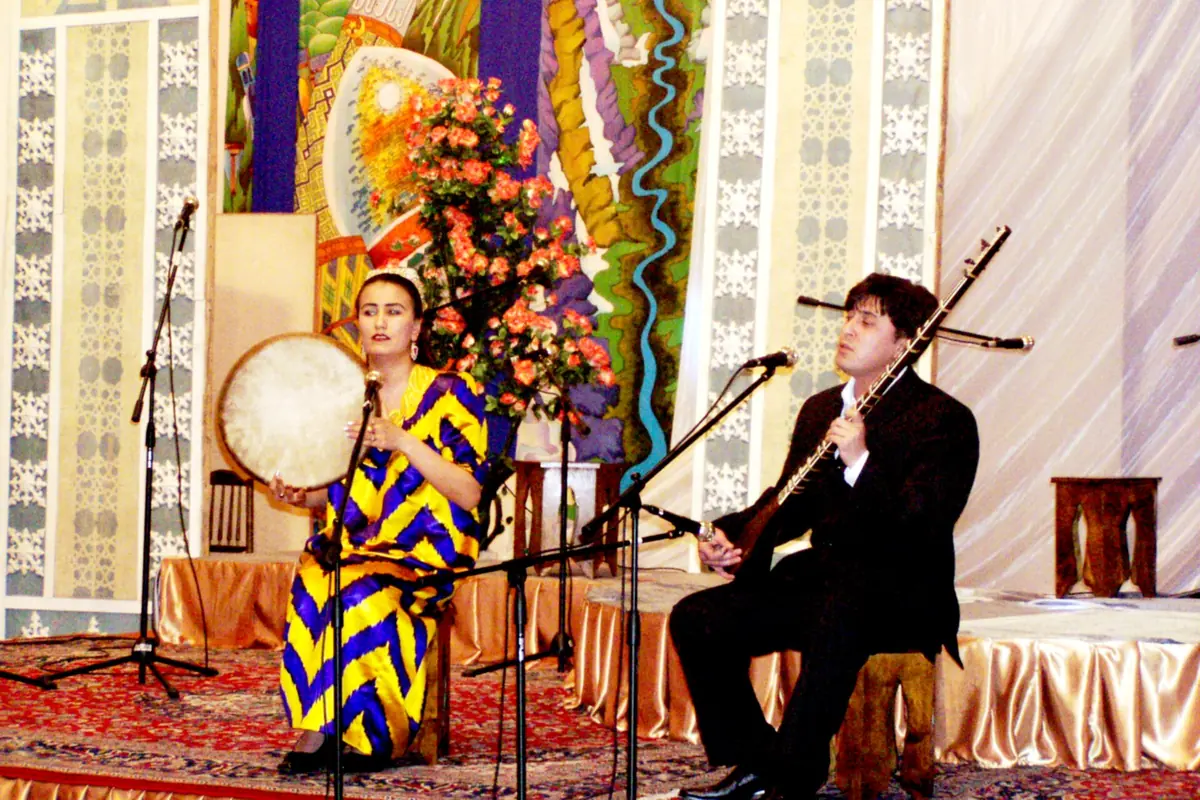
Shashmaqom, meaning six maqoms, is the classical music tradition of the urban centres of Central Asia. UNESCO describes a fusion of vocal and instrumental music, melodic and rhythmic idioms and poetry, performed solo or by a group of singers with an orchestra of lutes, fiddles, frame drums and flutes. It names Bukhara as the historical and spiritual centre of Shashmaqom. Wikipedia says the style is believed to have arisen in the cities of Bukhara and Samarkand. UNESCO inscribed it in 2008, and it says performances generally open with an instrumental introduction followed by the nasr, the main vocal section. UNESCO adds that the overwhelming majority of present-day Shashmaqom performers in Tajikistan and Uzbekistan are graduates of the Tashkent Conservatory.
The instruments you may meet
Wikipedia groups the traditional instruments of Uzbekistan into three families. The strings include the dutor, rubob and tanbur, all long-necked fretted lutes, the gʻijjak spike fiddle and the chang, a struck zither. The winds include the karnay, a long trumpet, the nay, a side-blown flute, and the surnay, a loud oboe. Percussion includes the doira, a frame drum, and the nogʻora, a pot-shaped drum covered with leather on top. A given performance uses only some of these, so the list is a vocabulary for listening, and not a line-up for any night. Wikipedia's article on Registan Square records that royal proclamations there were heralded by blasts on enormous copper pipes called dzharchis.
Costume in the dance
Costume gives a regional dance its look. Wikipedia describes ikat, a dyeing technique in which the resist is applied to the yarns before weaving, as common in Uzbek culture, and says Uzbek ikat is distinguished by bold and flamboyant patterns. The doppa is the traditional skullcap of the Uzbek and Uyghur peoples, with embroidered designs that can indicate the wearer's hometown, and there are several types distinguished by their embroideries or place of origin. In a staged dance, such details are what a viewer can learn to read, even without a programme note. The costume guide goes further. Wikipedia adds that the earliest depictions of the doppa are in 15th-century art from present-day Uzbekistan.
Read next: Uzbek costume: ikat, suzani and doppa
A hall show and a community occasion
UNESCO's descriptions place Lazgi and Katta Ashula at holidays, festivities and family events, and as part of how communities express themselves. A concert hall changes that setting: the audience is seated, the hour is fixed, and the material is chosen and shortened for visitors. That is not a flaw, but it is worth knowing. A staged show can introduce a tradition and its look and sound; it cannot reproduce the occasion for which the tradition exists. Treat an hour in a hall as an introduction, and read or listen further if one of the traditions catches your interest. That is true of almost every staged folk show in the world, and it is a good reason to read about the traditions before you go.
Reading the programme on your night
The Marokand Concert Hall ticket names no pieces, and performers can change, so no particular dance or song is promised here. What you can do is watch for the signals described above. If a scene is lively and the movements shift in pace, it may resemble the dynamic, interpretive form that UNESCO describes in Lazgi. Watch the costume, the skullcaps and the textile patterns, and listen to how the drum and the melody work together. If a tradition catches your interest, UNESCO's files for Lazgi, Katta Ashula and Shashmaqom are free to read and include photographs and film, so you can follow up at once.
Who this isn't for
This guide does not tell you what a particular night's programme contains, and it is not a scholarly survey. If you want a recital of the classical maqom repertoire, look for a dedicated concert rather than a theatrical revue. If you want to hear a community perform at a wedding or a holiday, that happens in living settings, not on a ticketed stage. If you want a deep and detailed history of Uzbek music, the Wikipedia article and the UNESCO files cited below are the place to begin. For a one-hour introduction to costume and dance, a hall show is a sensible start. It also does not cover the other regions of Uzbekistan, or Bukhara's city traditions, in the detail that a book would.
Frequently asked questions
What is Lazgi?
A dance associated with the Khorazm Region and now widespread across Uzbekistan. UNESCO inscribed it in 2019. It is performed during national holidays and folk festivities.
What does Katta Ashula mean?
Big song. It is a traditional song of the Fergana Valley, sung by a minimum of two and a maximum of five singers. UNESCO inscribed it in 2009.
What is Shashmaqom?
A classical tradition of vocal and instrumental music whose name means six maqoms. UNESCO inscribed it in 2008 and names Bukhara as its historical and spiritual centre.
Will the Samarkand show include all of these?
Not necessarily. The ticket names regions from the Fergana Valley to Khorezm, but pieces and performers can change, so no specific dance or song is promised.
Which instruments are traditional in Uzbekistan?
Wikipedia lists lutes such as the dutor and rubob, the gʻijjak fiddle, the doira frame drum, the surnay oboe and the karnay trumpet among them.
Sources