The city behind the hall
Samarkand from Marakanda to Timur
A short history of Samarkand, from the Marakanda that Alexander's army captured to Timur's capital and its UNESCO listing as a crossroads of cultures.
Reserve a seat in Samarkand ↗Quick answer
Samarkand is among the oldest continuously inhabited cities in Central Asia. Greek writers called it Marakanda when Alexander the Great captured it in 329 BC. It prospered on the Silk Road, was sacked by the Mongols in 1220, and became Timur's capital in 1370. UNESCO added it to the World Heritage List in 2001 as Samarkand – Crossroads of Cultures.
An old city on a trade road
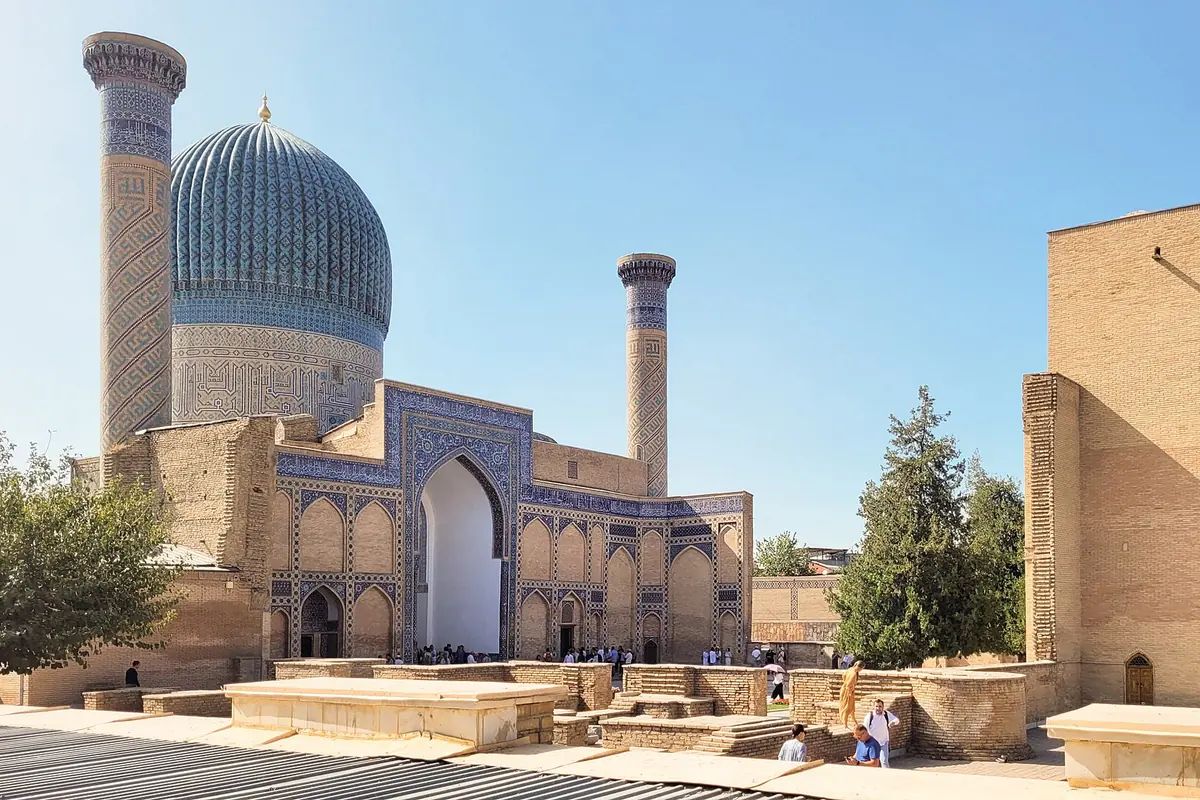
Wikipedia describes Samarkand as among the oldest continuously inhabited cities in Central Asia. There is no direct evidence of when it was founded, but researchers at the Institute of Archaeology of Samarkand date the city's founding to around 700 BC. It prospered from its location on the trade route between China and Europe, and became a major centre of the Sogdian civilisation.
Marakanda and Alexander
Alexander the Great conquered the city in 329 BC. The Greeks knew it as Marakanda, a name the Greek writers rendered as Μαράκανδα, and the Wikipedia article on the city says it was conquered at that time. It adds that, although Samarkand suffered significant damage in the conquest, it recovered rapidly and flourished under the new Hellenic influence. The concert hall's name, Marokand, is close to this ancient form.
A centre of learning and a caravan stop
Wikipedia says that Islam was introduced to the region in the eighth century, that the city became a centre of Islamic and Arabic learning, and that under the Samanids, between 875 and 999, it was an important node of trade routes. A legend recorded there holds that the first paper mill in the Islamic world was founded at Samarkand after the secret of papermaking was obtained from Chinese prisoners. Wikipedia presents it as legend, and the safest reading is that Samarkand was a place where goods and ideas were exchanged, and where a succession of rulers, Persian, Turkic and Mongol, left their mark on the culture of the city.
The Mongols
The Mongol Empire under Genghis Khan conquered Samarkand in 1220, which Wikipedia says saw widespread destruction. The city remained part of the Chagatai Khanate until 1370. Wikipedia quotes the Travels of Marco Polo, whose account of the late 13th century describes Samarkand as a very large and splendid city, and the traveller Ibn Battuta, who visited in 1333 and called it one of the greatest and finest of cities, and the most perfect of them in beauty.
Timur's capital
In 1370 Timur, the founder of the Timurid Empire, made Samarkand his capital. Over the next 35 years, Wikipedia says, he rebuilt most of the city and populated it with great artisans and craftsmen from across the empire. Samarkand grew to be the centre of the region of Transoxiana, and the Timurid period gave the city its best-known buildings, including Registan Square, the Gur-e-Amir, the Bibi-Khanym Mosque and the Shah-i-Zinda necropolis, which are known for their cobalt and turquoise majolica tilework.
A crossroads of cultures
UNESCO added Samarkand to the World Heritage List in 2001 as Samarkand – Crossroads of Cultures. Wikipedia describes the city as multicultural and plurilingual, with Uzbek as the main language and Russian also widely used in public life. A concert of regional Uzbek dance in a modern hall is one small way of seeing the same idea today: the culture of a place that has long drawn on many peoples, shown on one stage. The history above is the setting for such an evening.
Who this isn't for
This is a short summary and not a work of scholarship. Dates and spellings differ between sources, and Wikipedia itself notes the founding date of Samarkand is uncertain, so treat the figures here as the ones the cited pages give. If you want a deep history, start with the sources below and then a book. If you only want to book an evening show, the history is background, and the practical answers are in the guide to the hall.
Frequently asked questions
What was Samarkand called in ancient times?
The Greeks called it Marakanda when Alexander the Great captured it in 329 BC, according to Wikipedia.
When did Timur make Samarkand his capital?
In 1370, according to Wikipedia. He rebuilt most of the city over the next 35 years.
When was Samarkand listed by UNESCO?
In 2001, as Samarkand – Crossroads of Cultures.
Is Samarkand the capital of Uzbekistan?
No. It is the second-largest city, after Tashkent, and the capital of the Samarkand Region.
Sources